There is no market for this: LLM coding

So I’m an engineer, been coding a long time and love doing it. I’ve kept up with LLMs and vibe coding, and no exaggeration it’s the biggest change of my lifetime. I love it.

I’ll let others talk the downsides; I am not blind to them but here I want to reflect a bit on a recent project and how late-2026-LLM tools drove it. Let me set the stage:

  • I live in San Diego, where you can ride bikes and motorcycles year-round. Annual rainfall normally around 10″ and usually only for a few weeks, moderate temperatures and never snow or ice.
  • Lane splitting and filtering are legal in California.
  • EV chargers are common (I have L2 at home and at work!)
  • I commuted for three years on a Piaggio 350 so I know the issues.

More background – back when we chose the Chevy Bolt to replace the Piaggio, I researched EV motorcycles and test-rode the Zero DS/R. Cool bike, but

  • Over 20k USD
  • No traction control or ABS made for a scary ride with more risk than I wanted

But now, you can find used Zeros for way less. I saw a Craigslist post for a Zero SR/F a few miles from me for under $8k and dug in. The SR/F isn’t my first choice of models but that’s deal worth considering. The owner pulled the listing and I went looking for my preferred model instead, the SR/S. Here’s what I bought:
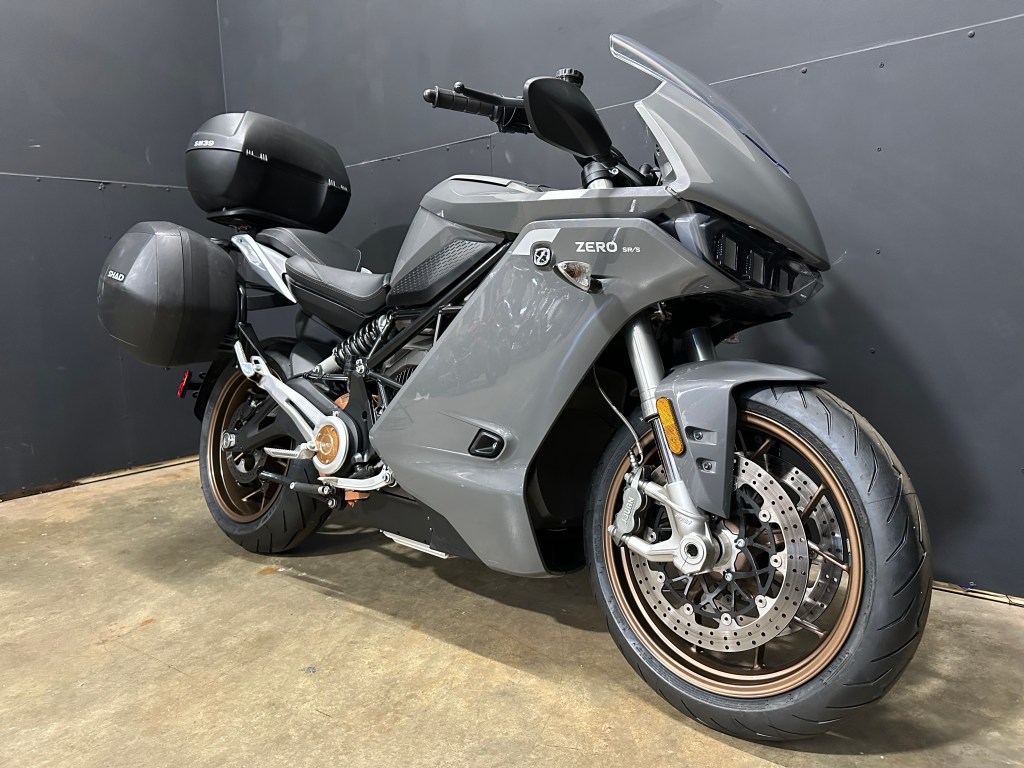
That’s a 2020 SR/S in Premium trim, with a battery replaced in 2025. (The 2020 and 21 models had a defect in their packs). With cross-country transport, parts swap etc I paid 11k for a machine with under 5000 miles. Cool!

Now I want a route-planning app

  • Fun rides – choose non-highway roads with curves, moderate speed limits and less traffic
  • Integrates charging stops
  • Knows about EV bikes – regen, velocity-squared drag, hill losses, etc.
  • Can send GPX files to my new Beeline Moto II.

There are plenty of apps for conventional motorcycles – Kurviger, for example. None for EV bikes. Why? Here’s the WSJ from 10/27/2026:
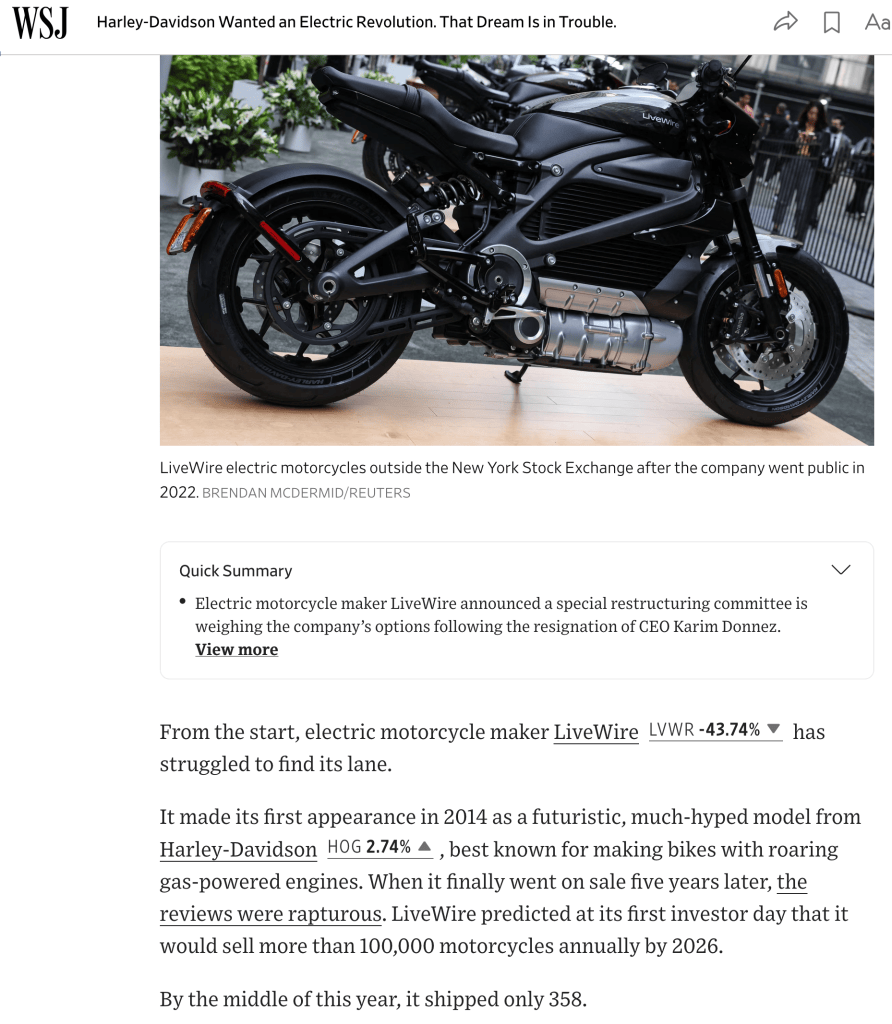
That’s one of the two big brands in the space. How about Zero?
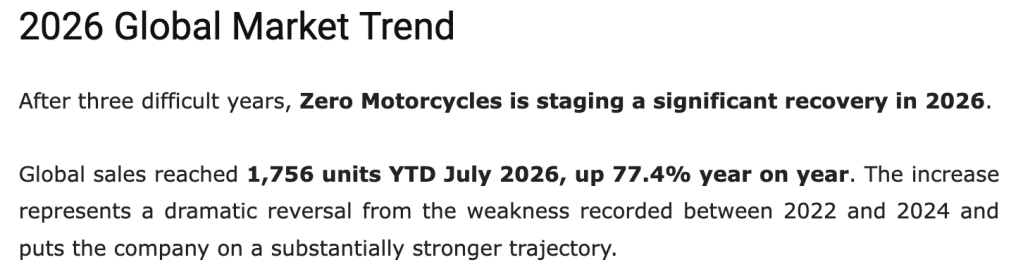
There is no there there

Harley thought they’d sell 100,000 per year and never cracked 1% of that. There is no market for this app, even if I sold to every single owner.

But I made it anyway:
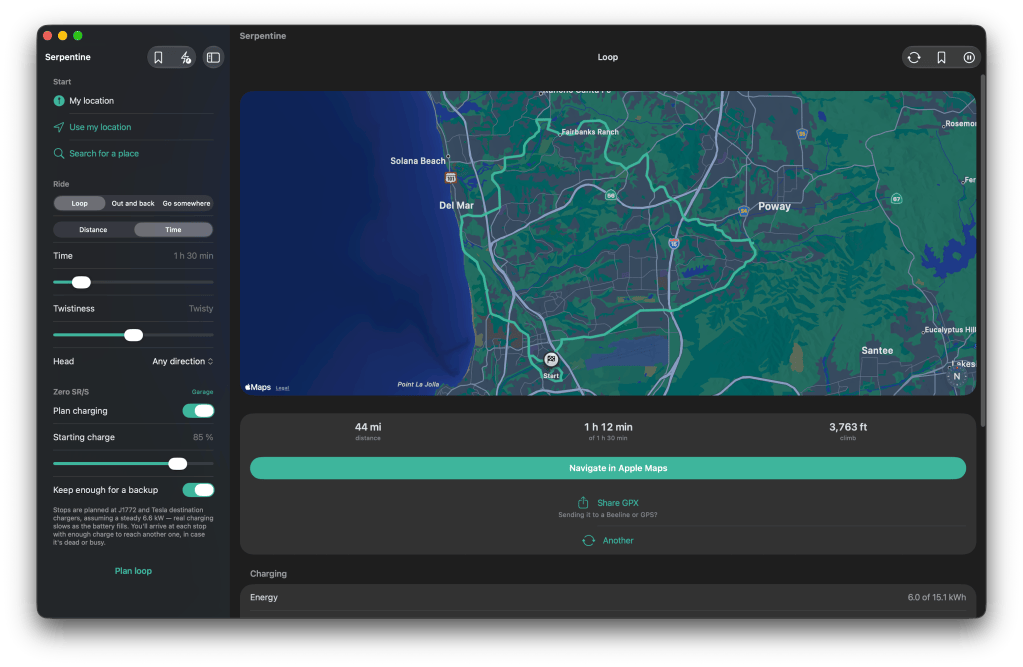
Some key ideas:

  • Planning for fun – loops, out and back, destination
  • Plan based on time (“I only have 90 minutes today”) as well as charge (“Bike is at 74%”)
  • “Just get there” mode to optimize for time if needs be
  • Oh shit – find me a charger reachable with X% battery
  • Handle charger data from multiple sources
  • Don’t reinvent the mapping or directions – integrate with them instead
  • Web, android, iOS and Mac support in various states.
  • Flexible for different bikes (L2, L3, plugs, DC, AC) and battery capacities. Currently support L2 J1772 and Tesla.

Try it yourself now, in the browser, at https://serpentine.phfactor.net/ – it’s not done but the basics work.

It’s a reasonably complex system:
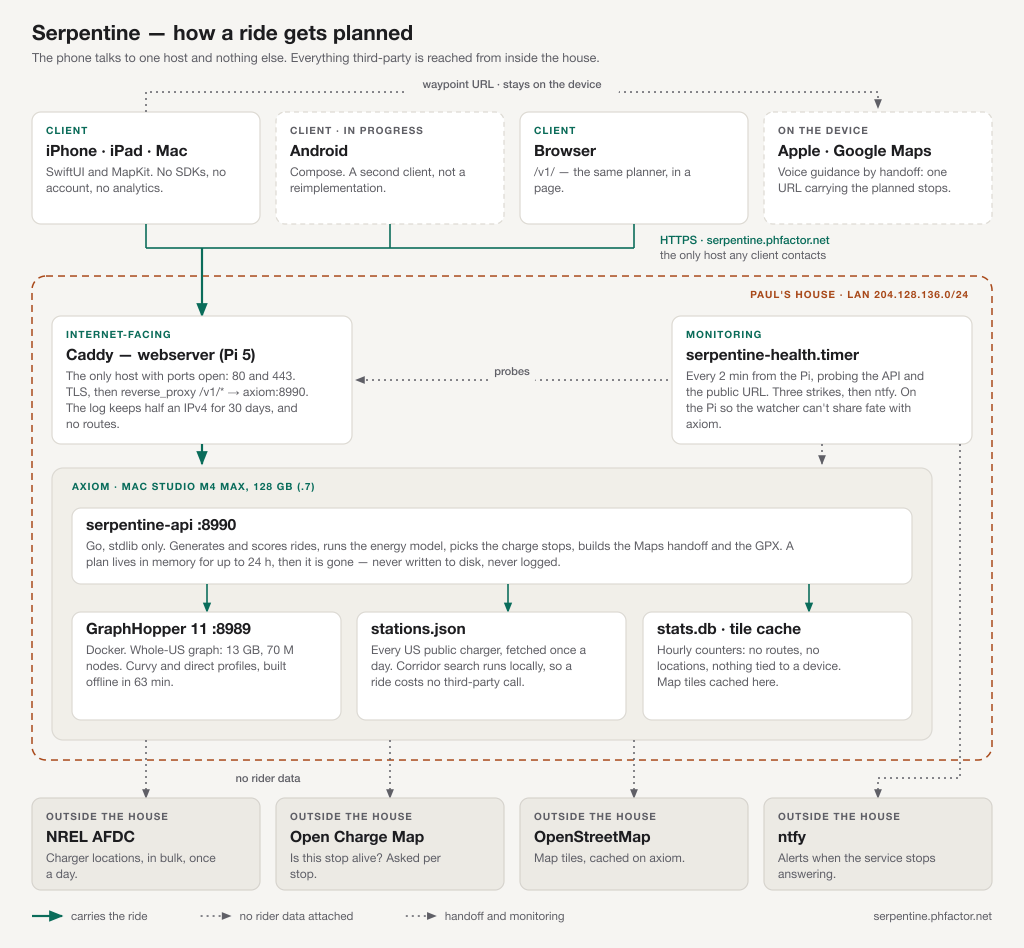
But as I said, there’s no market. So why build it?

  • Claude Code and friends make building complex, multi-layer systems feasible and enjoyable. I can literally do the work of an entire scrum team and I’m not exaggerating here.
  • Since the entire addressable market is maybe a thousand riders, I can self-host the front end and routing engine, and get by with free-plan limits for maps and such.
  • No need to monetize, setup accounts or billing. If I keep costs low, I don’t need ads either.

Vibe coding is an earthquake. Spin up a layered, multi-dependency system with complex multi-vendor data integration, real time API, multi-platform clients? Days. Need a from-spec implementation in another language and platform (Android)? Again, days. Refactors? Bugs? Complex Apple release process? All ten to one hundred times easier.

LLM disclosure – Claude drafted the next three paragraphs after reading the first version.

Where vibe coding bit me. Twice, and both times the same pattern: the code was fine and the writing about the code was wrong.

My notes said the Caddy config was “deployed and verified.” Half of it was. The routing rules were live; the log filtering sitting right above them had never been copied to the Pi. So for two weeks my public site logged full client IPs, request headers and un-collapsed tile paths – which are map coordinates – while the privacy policy I had published promised truncated addresses and 30-day retention. I caught it by reading the deployed file instead of my own note about it. Fixed it, then deleted the 2,459 records collected under the old format rather than let them age out. But hey! Zero users except me and a buddy, so zero consequences.

The Beeline was the second one. Claude had a careful model of how the device imports GPX files, written down as fact. Everything testable on my laptop – file shapes, size limits, schema order – was right. Every claim about the hardware sitting on my desk, untouched, was wrong. All four.

That’s the failure mode, and it isn’t bad code. An LLM will hand you a confident sentence about something it never checked, and it reads exactly like the sentences about things it did check. Both of those bugs were in English, not Go. Test cases, manual testing and log spelunking help, but neither bug was in code — what caught them was checking the running thing instead of the note that said Claude checked it.

My opinion after a year-plus of intense vibe coding

Try things. Build bigger. Solve small problems because you want to and no one else has. It’s a new world.

Links

Design your own toolbox on the cheap

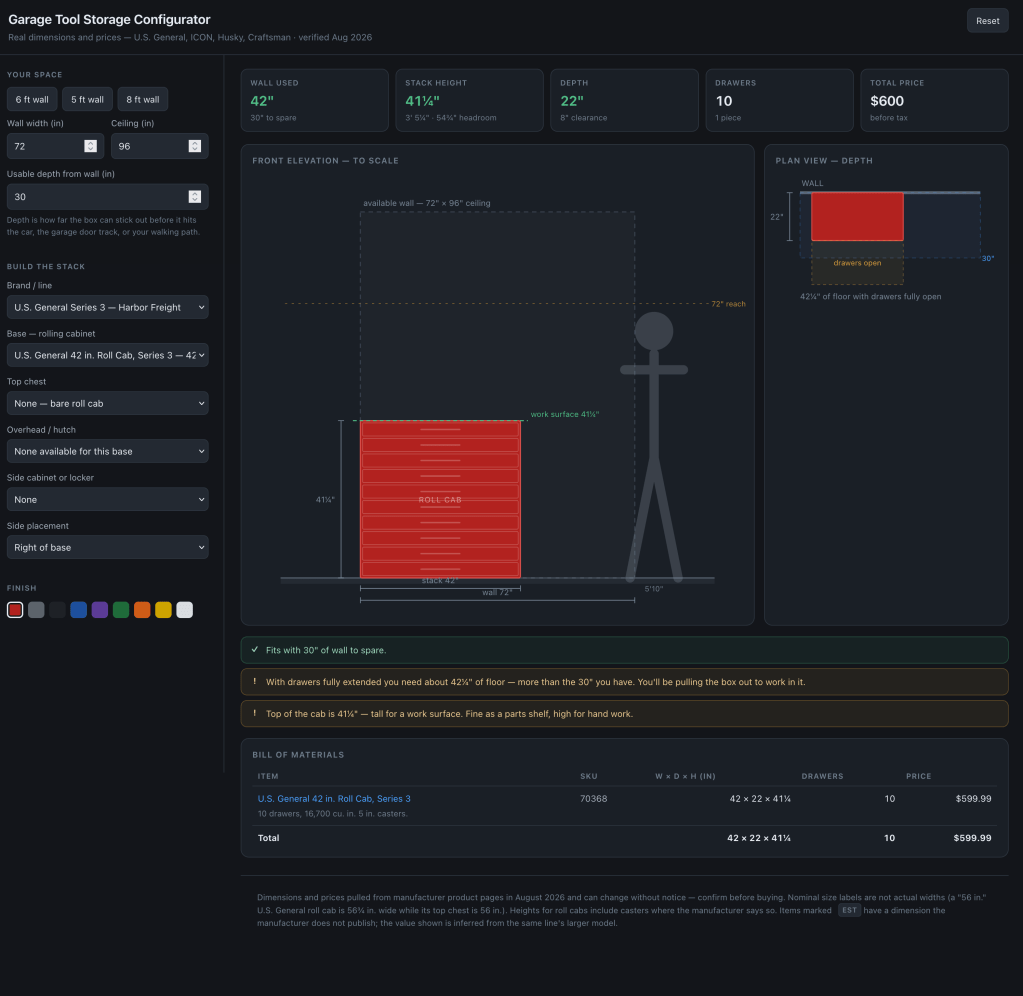
I wanted a simple web tool to build an inexpensive toolbox setup that fit my garage space, and the only one I could find is the unaffordable Snap-On. So Claude build me one that uses Harbor Freight, Home Depot and Lowes. Simple 2D visualization, bill of materials, costs as of today.

Free, no ads, no tracking, will work fine saved as a web page. https://www.phfactor.net/toolbox-configurator.html

Hope someone else finds this useful!

Lululemon adds a tall-sized trouser and it’s good

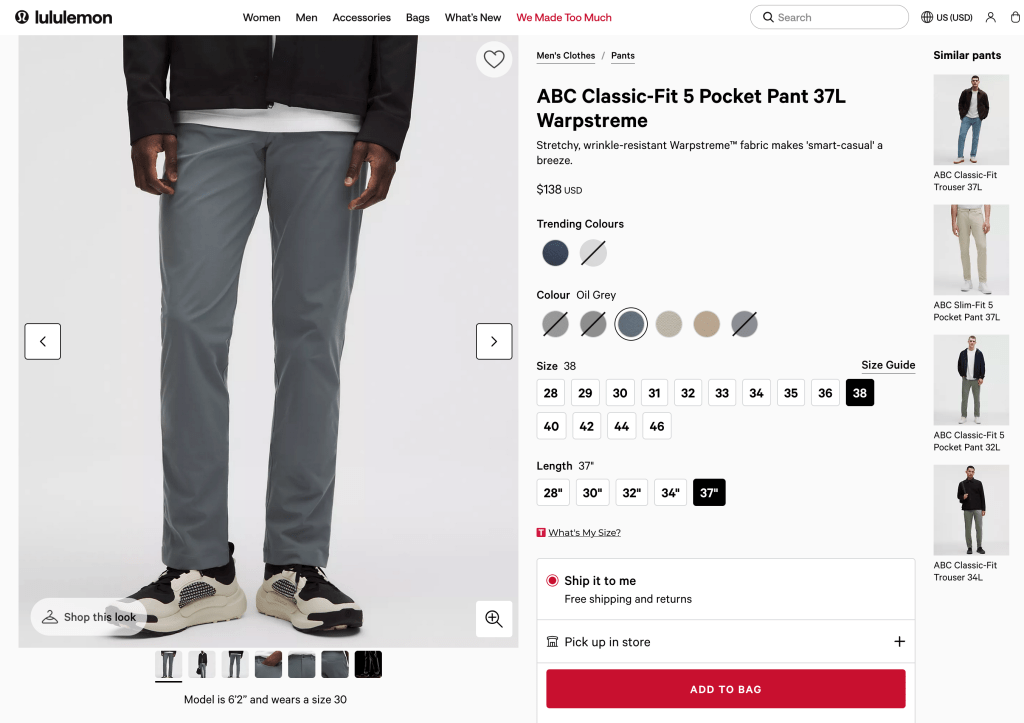
So I have an Clothing for tall men post for good reason – at 6’10” there are few options. Recently, I was watching this video about workwear and he briefly compares the crotch gusset to that of the Lululemon ‘ABC’ pant. I was intrigued, so I watched his video about the ABC Pant, in which is quite positive. This is unusual, he’s expert and incisive. It sounded like an honest to god well-made, well-designed functional pair of trousers for an acceptable price ($138 as of today, or $117 after the signup discount.) I also have a Lululemon gym bag from work (freebie for getting a patent) and it surprised me at how much I like it. So I was curious enough to go to their website and check them out:

Dude! 37″ inseam! That’s my size.

My pair arrived today; I’ll spare you a picture but they are excellent – beautifully made as the video explained (No B surfaces anywhere), have a good phone pocket and a sub-pocket for the Victorinox, inseam is long enough, super soft and comfortable and the tech-pant-sheen is minimal.

(The guesset is as described. ABC. Look it up.)

Anyway, Lululemon basically only has the 5-pocket as their tall size. Nothing in shirts or other trouser styles, but these are 100% wheelhouse for me and I’m quite pleased. I think they will be perfect for my next travel adventure, and of course bike errands or at the office. A bit pricy, but I actually feel for once that, having watched the teardown video, I’m actually getting value for my money. That I can recommend. That earns it a place on #YouShouldBuy.

Song Exploder

I was in an around music and music production for a long time, so I’ve long enjoyed the Song Exploder podcast where “musicians take apart their songs, and piece by piece, tell the story of how they were made.” Not every episode has music that I like but hey, it’s a podcast, skip those.

I wanted to post about today’s episode, which took me all the way back to high school: Thompson Twins “Hold me now”. It’s fantastic.

My favorite is probably Chvrches “Clearest blue”. But peruse the episode list and see if anything looks interesting. If you’ve never heard a song explained, you will be surprised at the time, love and craft behind a pop song.

Poem fragment for the day

This is from my all-time favorite book of poetry, ‘Reservations’ by James Richardson. I’ll share two stanzas from ‘The Tracks’ that have always left me breathless with sheer awe at how well he writes.

And it is hard even to imagine
the neighbors in a bath of light
playing small cards
their windows in precipitous lines

downhill to where the silence leans
like blocks of onyx quarried
from the white moon,
tomorrow already in ruins.

A Richardson aphorism for today

I had lunch with an old friend recently and quoted Richardson to him, which reminded me of my neglected post series. Here’s one from Vectors 3.0:

“143.
The audience is faceless, back rows disappearing into dimness, and it doesn’t talk back. Find your audience and you will blather. Write, instead, to the listener at your table for two, the one in your head whose faint blush, half-smile, glazed eyes make you correct course in midsentence, back off, explain, stop to listen.
”

Excerpt From
By the Numbers
James Richardson

https://www.coppercanyonpress.org/books/by-the-numbers-by-james-richardson/

Good blogging advice also!

Meshcore

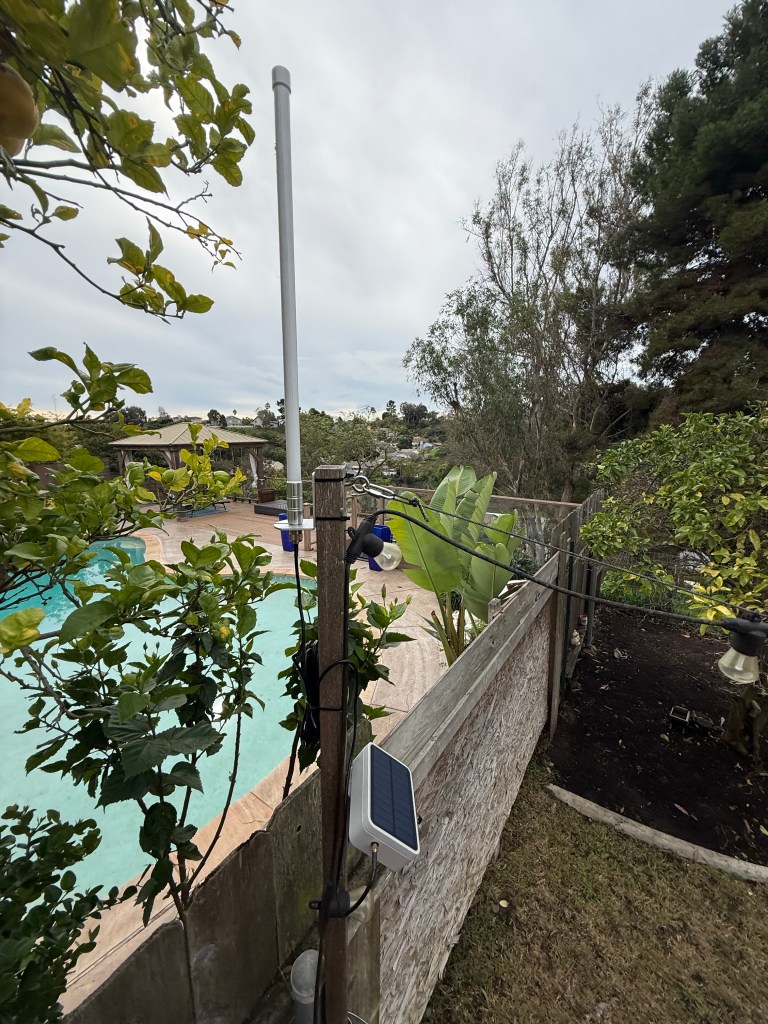
Cute, no?

That’s the repeater. More about it later.

I have a complicated history with ham radio. Years ago, a friend/co-worker and I got our one-day ‘Technician’ licenses, and for years after that I tried to make first contact. Like, talk to anybody. I learned about bands and power and radios and repeaters and programming software and hackable firmware and only managed walkie-talkie on FRS and GMRS. Suuuper frustrating.

I was recently emailing a former co-worker (Hi, Jon!) who’s taken up ham radio as hobby and somewhere in there we started talking about Meshtastic. Then in December it made front page on either Tildes or Lobsters and I was intrigued. Especially this story about using it on sailboats. And this followup post. I also sometimes watch his videos, so this Jeff Geerling post was also valuable.

Key bits:

  1. It’s inexpensive – radios are $50 to $150, repeaters $100 to $300. Software, protocol and firmware are all open source.
  2. It’s in the no-license-required ISM spectrum, meaning that you don’t need a ham or GMRS license.
  3. It’s low power, so a radio can run for days, a repeater can be compact and solar-powered and you don’t need to plug stuff into the wall.
  4. No need to drill holes in my house for coax or power because of #3.
  5. It’s super limited: Line of sight, text messages. No pictures, no web pages.
  6. It looks like low-stakes fun to learn and use.
  7. Radio and repeater programming is via a web page – no programs to install! Yay Web Serial.

Based on some research, I ordered

  1. Two Seeed SenseCAP T1000-E cards (waterproof, 2 day battery, GPS included) via Amazon for $51 each.
  2. Lilygo T-Echo (e-ink) via eBay for $110
  3. Lilygo T-Deck Plus with GPS via Amazon for $102. This is the Blackberry-looking radio seen above.
  4. Heltec v3 with e-paper display via eBay for $55.
  5. RAKwireless Wismesh Repeater Mini plus wall and pole mount from Rokland for $130
  6. High-gain 8dBi antenna from Amazon for $44.

Note that I’m simplifying here a bit – the repeater came later, and the antenna was a recommendation from the ‘San Diego Mesh’ Discord.

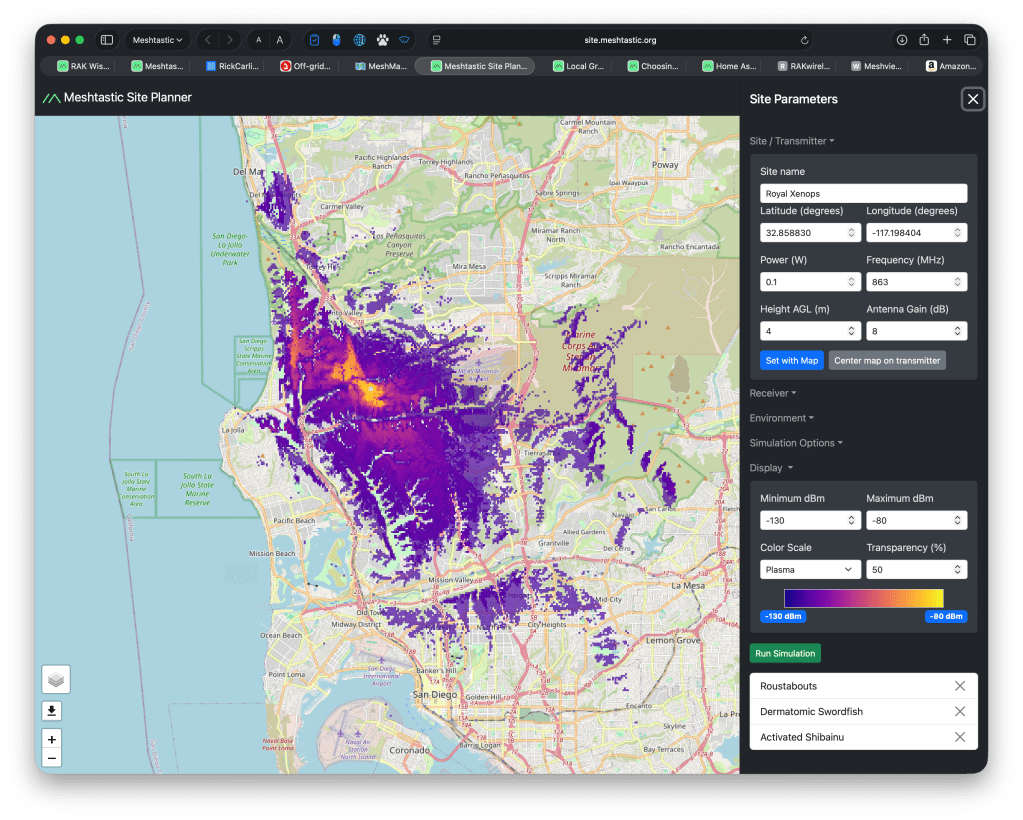
The Meshtastic site planner predicted that the repeater + antenna would provide incredible coverage. Remember that this is based on a tenth of a watt! Like, less than a single display LED:

Cue detours in aforementioned Discord group, learning about device roles and the tyranny of Long-Fast, and I was back to not being able to talk to anyone.

In searching for help, I found that many folks had gotten frustrated with the design tradeoffs of Meshtastic and had started a newer project called Meshcore to address them:

  1. Designed to scale to more nodes and distance. (Claimed. I’m not competent to judge)
  2. Works on the same devices and frequencies as Meshtastic, so you can try one or both just by re-flashing devices. This in particular was compelling.
  3. Simpler configuration

More about Meshcore:

  1. Main site
  2. Web-based flasher/programmer (which works notably better than the Meshtastic one)
  3. Map of radios and repeaters and this community map and this West Coast Mesh map.

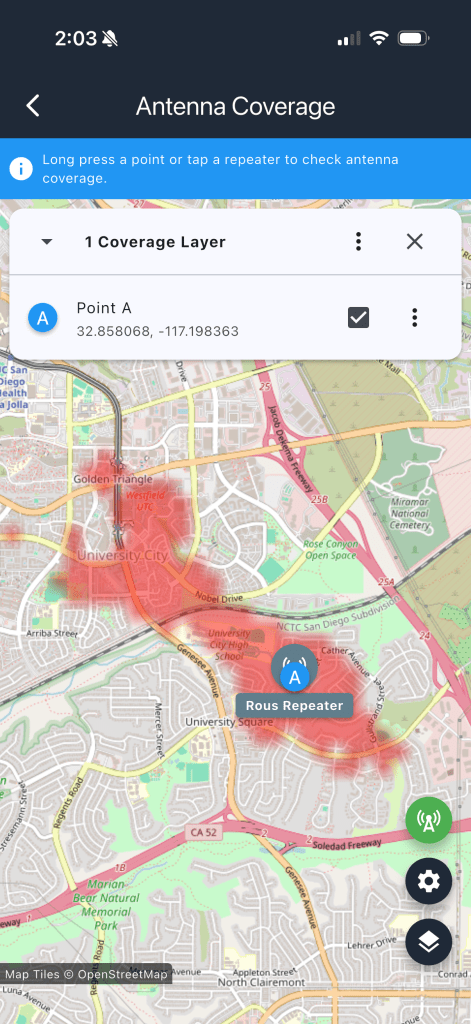
So I spent half a day building and installing the repeater in the back yard only to a) not see traffic or get more than a single response and b) the estimated coverage was really shit:

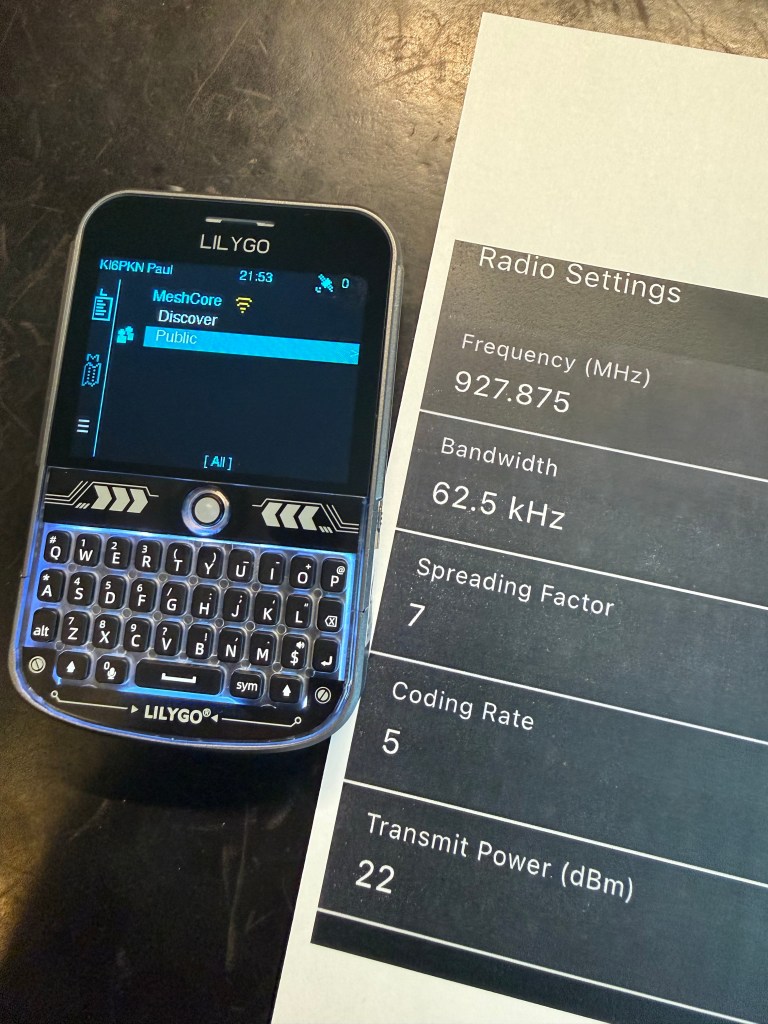
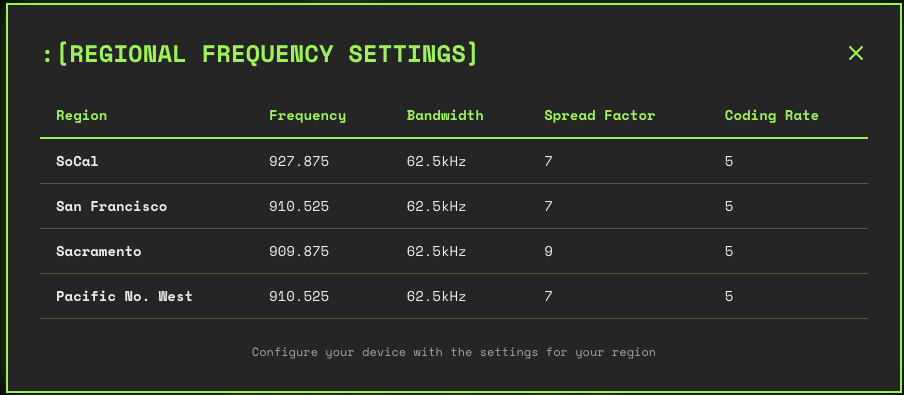
One of the folks on the Discord sent me the key information: as seen on the West Coast Mesh page, local radios do not use the USA presets for frequency, bandwidth, spread factor and coding rate. I had been talking to no one! Here are the correct settings:1

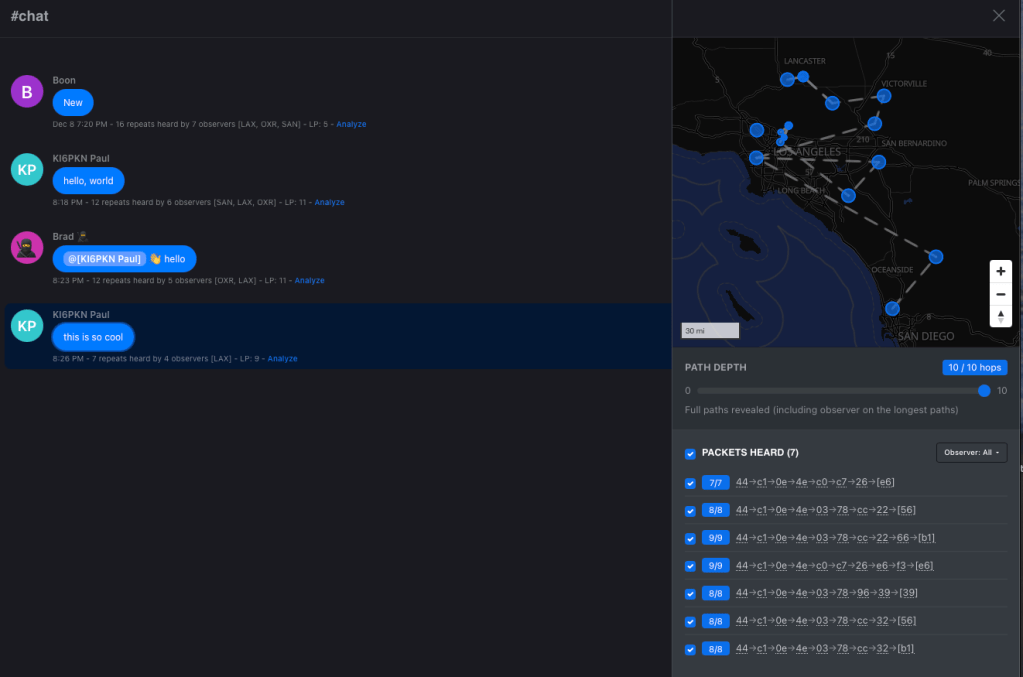
That made the difference! Now I can see and talk to people. Here’s a chat from me, using the iOS app to a T1000-E card to the repeater, going 10 hops to get north of Los Angeles:

That trace is from the very useful tool here, by the way. Just click on a message to see its trace.

Key things to know

  1. One of the two T1000-E cards is basically bad – after DFU reset, it’ll program and then not work. The WisMesh Tag from RAKwireless is supposed to better and more reliable. Others have also had issues with the T1000-E.
  2. The Lilygo T-Echo sorta works.
  3. The Heltec V3s all murder batteries – like an hour. Get V4 or something else.
  4. The Lilygo T-Deck is pretty awesome but you have to select the ‘use SD card for storage’ version of the firmware or else you are limited to 6-character channels.
  5. The repeater seems to be good, but you gotta get that antenna way up high. I will try to do so – roof? PVC pipe as mast? Tree? Dunno yet but right now I can’t reach the friend I’ve convinced to try this with me.
  6. It’s not super useful. The real uses are stuff like cellular outages, off-grid camping/hunting/hiking, remote no-infrastructure land use and nerding out.
  7. My repeater is now showing up on on the WCMesh Map after I uploaded it. I am unreasonably pleased with this. Repeater public key is 4450A0B0C86FC09D7193196DE7C29078AACFB2999E75F06FE2C41C7E35861434
  8. There’s a ‘room server’ feature where you program a radio to basically be a BBS / IRC server. This looks really cool, I see quite a few on the network and looks fun to try out.
  9. Hashtag channels are public and ad-hoc. Try #test, #chat as well as the Public channel. Locally we’ve also got #sandiego.
  10. Check this for a local group and their Discord. That got me unblocked several times, as well as advice on antennas and more.

Hardware I’d recommend to try it out based on a week or so:

  1. Lilygo T-Deck+. I got mine from Amazon but it took weeks to arrive. Maybe look for in-stock.
  2. WisMesh Tag from RAKwireless – about the same $50 as the T1000-E card but reportedly better.
  3. If you need a repeater, my Wismesh Repeater Mini seems good. I like that it’s install-and-forget due to the solar+battery, plus I can check and administer it locally with Bluetooth or over the Meshcore network using the app. The consensus on Discord was that the 8dBi antenna is essential once you get past basic local use.

If you want to spend the least in order to see if anyone’s using it locally, I’d suggest checking the maps above first and then trying the WisMesh Tag or T-1000E cards.

I’m having a lot of fun. You might too.

Melanzana hoodie makes the list

A week or so ago, I read in the Scope of Work newsletter about a Colorado brand of hoodie called Melanzana:

  • Here’s a workshop and showroom tour of the Melanzana cut-and-sew shop in Leadville, Colorado. Here’s an interview with Melanzana’s founder, Fritz Howard. Melanzana produces all of their clothing in Leadville, a town of about 2600 people which, at over ten thousand feet above sea level, is the highest incorporated city in the US. This makes it challenging for them to expand production, and ultimately constrains their growth as a company. They handle this partly by selling the vast majority of their product in-person at their showroom, which actually requires appointments for most purchases and has a per-customer, per-visit limit on the quantity of clothing one can purchase. 

    I find Melanzana’s business strategy counterintuitive and unexpected, and I suppose it helps to explain the fact that I was totally unaware of Melanzana until a couple of months ago, when I was given one of their hoodies more or less by accident. What has remained a mystery, though, is the honestly shocking amount of attention this hoodie has received since then; it’s easily the most commented-upon garment I’ve ever owned, with both friends and strangers calling the brand out by name and complimenting the sweatshirt’s frumpy yet somehow athletic drape. I guess this is all to say that Melanzana seems to have forged their own idiosyncratic moral framework, and has somehow managed to convince a large number of New Yorkers that that framework is worthy of their attention.

I did a bit of looking and the video by MyLifeOutdoors was convincing – I managed to time a release on the site and bought the micro grid hoodie. It’s gonna get a lot of wear, and I figured it for something worth sharing. Melanzana reminds me of the Patagonia ethos – made for use, treats the employees well, does repairs and isn’t trying to grow endlessly. Good stuff.

Added to the YouShouldBuy tag, my highest praise.

(Oh yeah, Scope of Work is also a recommend.)