Wildfire intensity scale

Years ago, during the 2016 Fort McMurry wildfire, I read an article that I should have bookmarked that discussed wildfire in physics terms – watts per square meter. Above some threshold, you literally and actually cannot douse the flames. Today, with the LA fires raging, I went searching and found this PDF by Joe H Scott. Seems that the standard is from Byram, G. M. 1959. Combustion of forest fuels. In: Forest fire: Control and use, 2nd edition. New York, NY: McGraw-Hill: chapter 1, 61-89.

Here’s the key bit from the Scott paper:
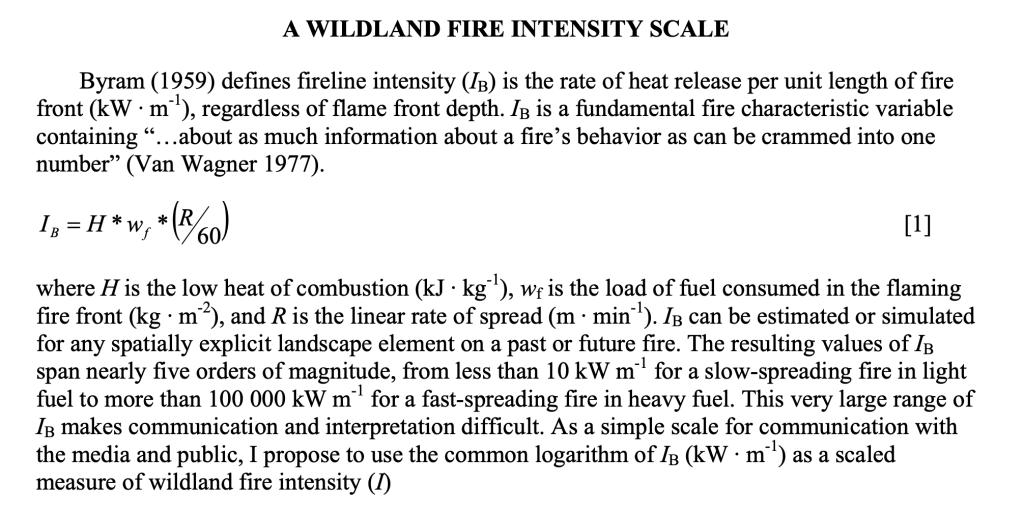
So a basic wildfire is ticking along at 10kW per meter, and a rager might be 100 to 150 megawatts per linear meter.

Goddamn. No wonder you can’t extinguish them.

By way of comparison, a gallon of gasoline has around 33 kilowatt hours of energy. If I estimate right, a big fire is equivalent to a gallon of gas burned over a 15 minute interval. Not sure that helps my intuition, and I often get stoichiometry wrong anyway.
Excellent news and a reading recommendation

For years, I read the absolutely amazing ‘Do the Math’ blog by Tom Murphy, a UCSD physicist carefully explaining so! many! things! (Energy: generation, storage, usage, loss. Details of his lead-acid solar/battery home setup. So much more)

Now the good news – his dormant blog tells us that he’s written a textbook based on on that work, and even better its been vetted and revised and best yet? Free online and inexpensive if you want a print copy. I cannot recommend this enough. https://dothemath.ucsd.edu/2021/03/textbook-debut/

Six feet is the wrong model

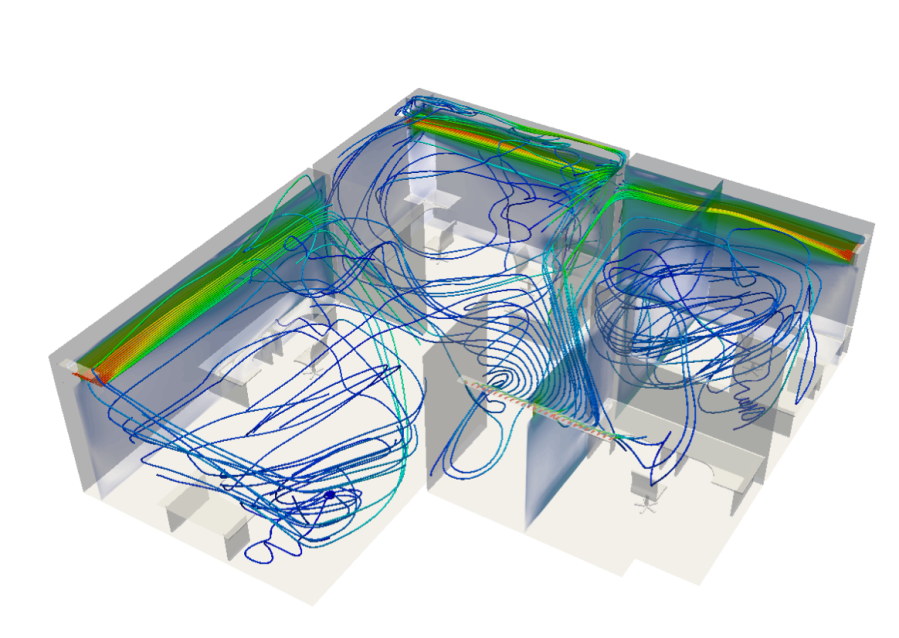
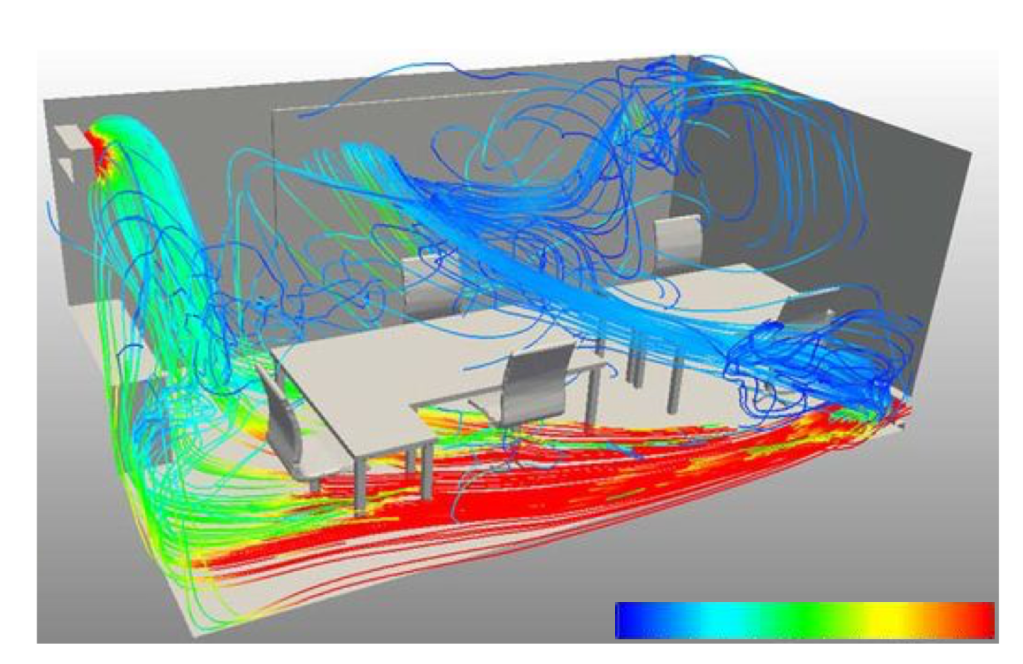
A friend sent me this paper on Arxiv.org – “A physicist view of the airborne infection” by Luis A. Anchordoqui and Eugene M. Chudnovsky. They used SimScale to model airflow in an office and included a couple of nice visualizations:

The paper is quite concise and worth your time, just under 2.5 pages. Short version? Six feet ain’t enough and your office is a Petri dish.

From the physics point of view, we cannot find a good justification for a stationary 6-feet separation in a situation when people spend long time together in a room. Droplets containing the virus move in the air via convection. The convection pattern in a room can be very complex; see Fig. 1. It depends on the location of air conditioners, radiators, windows, and all items in the room, as well as on people producing vortices by moving around. The existing vortices in the air can make a location far away from the source of droplets more dangerous than the location 6 feet away. This applies to meeting rooms, office spaces, supermarkets, department stores, etc. The airflow pattern should be studied for all such facilities to avoid the spread of infection to large distances from a single infected person. The safest rooms must be those equipped with the air sucking ventilator at the top, like hospital surgery rooms

Luis A. Anchordoqui and Eugene M. Chudnovsky

https://arxiv.org/pdf/2003.13689.pdf?referringSource=articleShare