

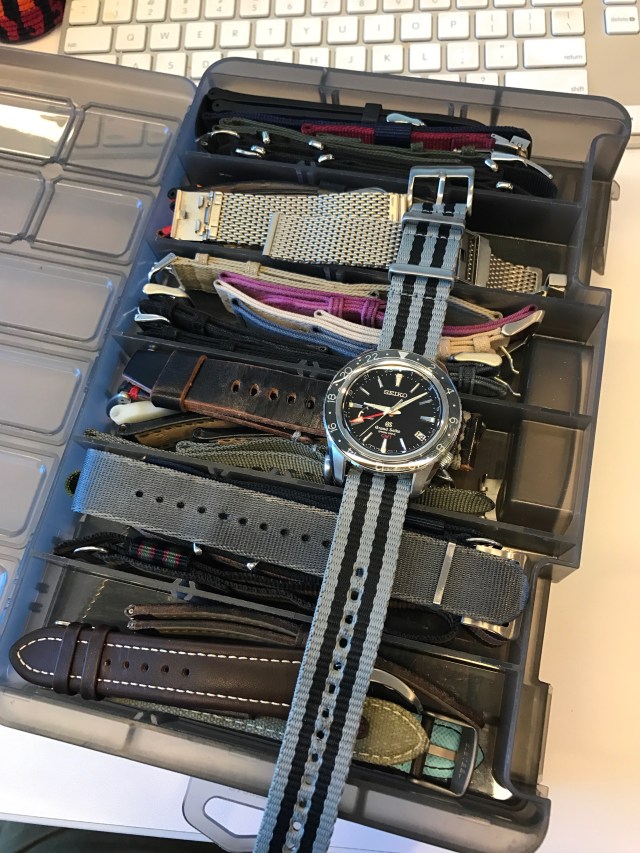
A friend asked me for a few sources of watch straps, so I’ll start a page here that I can share around. I’ve bought a lot of straps and bracelets, probably in the 1-2k range if you count watch-specific bracelets, so I’ve got lots of opinions to share. Here’s a quarter of my current collection:
But first, Paul’s Rules for Strap Acquisition:
Rule 1: Always
… buy the bracelet. Often, watches are offered with and without the bracelet. Buy the bracelet when you get the watch even if you don’t want it immediately.
Why?
Because bracelets are specific to a watch. In particular, the end links are nearly impossible to fit and/or find properly. So buy the bracelet; swap it it out if you want but I’ve never once regretted having it. They cost a lot more if you return post-sale to buy the bracelet by itself. For example, IWC wants over $1,000 for an Aquatimer bracelet.
Similarly, if the factory strap has a ratcheting/extensible clasp, buy it. See that post for reasons and details.
Rule 2: Never
… buy the factory leather straps. They’re OEM’d anyway, the markup is severe, and since leather only lasts a year or two, your value for money is poor. Buy a fancy custom one from ABP or Camille Fournet if you want, it’s still a better deal.
If the factory buckle or deployant is to your liking, you can often buy them separately and they are easily fitted to a strap.
Rule 3: Rarely
… buy watches with non-standard lugs. Oris Aquis, IWC Aquatimer, VC Overseas, Tudor North Flag… all great watches, but finding third-party straps is at least a hundred times more difficult.
Let’s Spend Some Money
This page will probably need lots of expansion and edits; for now I’ll sketch out the major topics and links for later. Leave a comment if you want, it’d be good to know which pieces are useful to know more about.
How to Shop
I was going to write this up, but this Barton page does it better. Read that and come back. Covers sizing, how to fit a NATO, wrist size and more.
If you want more opinions, there’s a WUS forum dedicated to straps and bracelets that is a deep well of knowledge.
Shops and Vendors
High-end leather
For leather, I recommend kangaroo for versatile/comfort, Cordovan for sheer beauty, and calf for comfort/price. You can get real alligator, but it’s import/export controlled, meaning that you need paperwork to sell a watch with a gator strap, and the one I bought isn’t all that awesome.
- ABP High end, think 200$ per strap and up, first-rate reputation and well worth a visit if you’re in Paris.
- Camille Fournet Also high end, the last RGM I bought had a CF strap, probably mostly 100 and up.
- Hodinkee Nice stuff, also expensive, well photographed and curated, overpriced in my opinion.
- Worn and Wound Similar to Hodinkee but about 80% of the price.
- Christopher Ward sells a superb Cordovan leather strap with a Bader deployant (found via this review) that is amazing. It’s not cheap at $125, but the quality of the leather and clasp is easily 3x the price, there’s no discernible difference from the Omega deployant and leather. I bought one of these for my Omega Globemaster and I love it.
- I’ve bought bunch of varied mid to high end straps from Global Watchband, they also sell alligator from $200 to $400 each. I get my Hirsch from them as well as my Cordura.
- OWC Kangaroo – the best $100 strap that I’ve ever seen. 20mm only, with fixed tubes that necessitate drilled lugs, but OMFG ‘roo leather is the best. Full review to follow.
Pricy but cool
Erika’s Originals MN straps are like $80 each, but the backstory (French parachutists, see this story) and actual straps are very cool. I have two, and they work on lugs from 20 to 22mm and are pretty good especially in hot weather.
As of August 2018, Erika has a lower-priced competitor in The Watch Steward. According to this WUS thread they are solid competition. I’ve not seen them yet.
Also cool is the Hirsch Robby sailcloth. It’s $110, very expensive for a rubber strap, but the build detailing and comfort are worth it to me. Instead of a slab of rubber, it’s articulated and vented, so you can wear it with less induced sweat when the weather heats up:

the Robby is my pick for best rubber strap I’ve had.
Segmented polyurethane
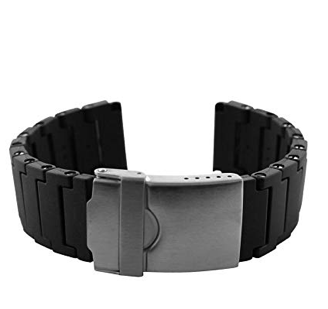
I think these were introduced with the JLC Navy Seals or maybe the Luminox 3000 series. It’s made a like a bracelet, with individual links, but instead of metal the links are plastic and thus very lightweight. They’re a bit pricy at $35, but I quite like mine. Also note that you can use an Exacto to fit them into smaller lugs, I shaved a 22mm into a 20mm and it looks okay. Get them on Amazon.
Affordables
You don’t need to spend a hundred bucks to get a great strap, let’s talk both vendors and materials for straps that you can afford and stock up.
Vendors
- B&R Bands is great. Straps under ten bucks, all sorts of materials, some with quick release, a good way to try a few styles and colors.
- eBay and Amazon, of course.
Materials and styles
Silicone rubber – undoubtedly the Barton 2-piece silicone:

This are about 1/9th the price of the Robby and have quick release, it shouldn’t surprise you that I have quite a few of these!
Canvas
I used to buy these from Timefactors and had quite a few:
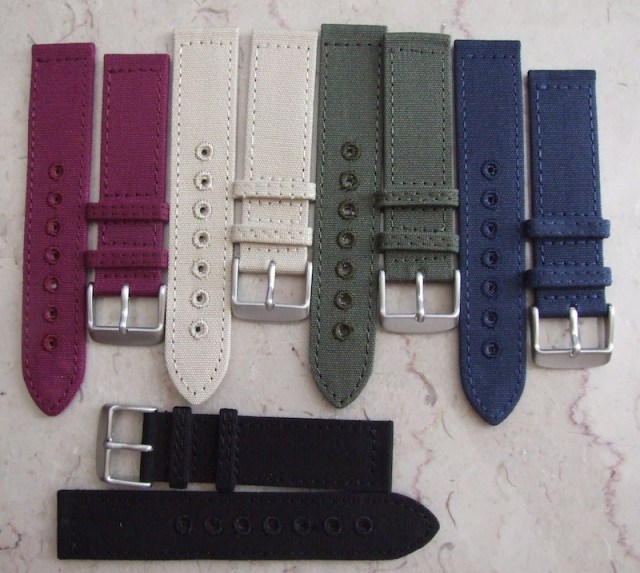
However, they no longer list them, so now I buy and recommend the Barton 2-piece quick release, which I get via Amazon. Well made and I love the quick-release straps.

Nato & Zulo
So many options! Here, my favorite vendors are:
- BluShark makes high-quality seatbelts especially, the AlphaShark here on my Seiko is a very comfortable strap.
- Haveston makes really cool and thicker straps with pretty color ways. I’ve yet to buy one though.
- ToxicNATOs has gotten more of my business than all others combined – their Blue Falcon and ShizNit (seatbelt) straps are my go-to favorites. Highly recommended.
Perlon
These are different. They fit literally any wrist, since the tang goes into the weave, and they’re like eight bucks each on cheapestnatostraps.com. I bought a fistful and promptly lost them all to my daughter who loves being able to color-match any outfit in a few seconds. Good in warm weather, waterproof but can poke your skin a bit with loose plastic and they definitely look a bit cheap.

Bracelets
As I said above, this is hard. Here’s the only time I’ve managed good end-link fitment:

That’s a cheap ($20ish) 3-link Oyster with hollow end links, that I painstakingly hand-filed to fit the watch. It took a couple of hours, and the bracelet is still uncomfortable with sharp edges. So yeah, but the factory if you possibly can.
For bracelets, start at Strapcode. Good stuff. I’ll have more posts on bracelets since there’s lots of depth here to explore.




 ultracrepidarian