A local rental that work paid to ferry the CEO. Looks like a labor of love to skin it like the movie prop.


ultracrepidarian: a person who criticizes, judges, or gives advice outside the area of his or her expertise.


A local rental that work paid to ferry the CEO. Looks like a labor of love to skin it like the movie prop.
One of my ongoing joys in life is a weekly-ish email from the ‘All of Bach’ project in the Netherlands. Not just a well-filmed and recorded performance, but conductor/performer notes and historical context.
I have a few performances of the cello suites, and prefer Rostropovich but this is well worth your time.
It’s odd, I’m used to modern rapid-rewards, short attention span videos so these require a bit of focus to watch.

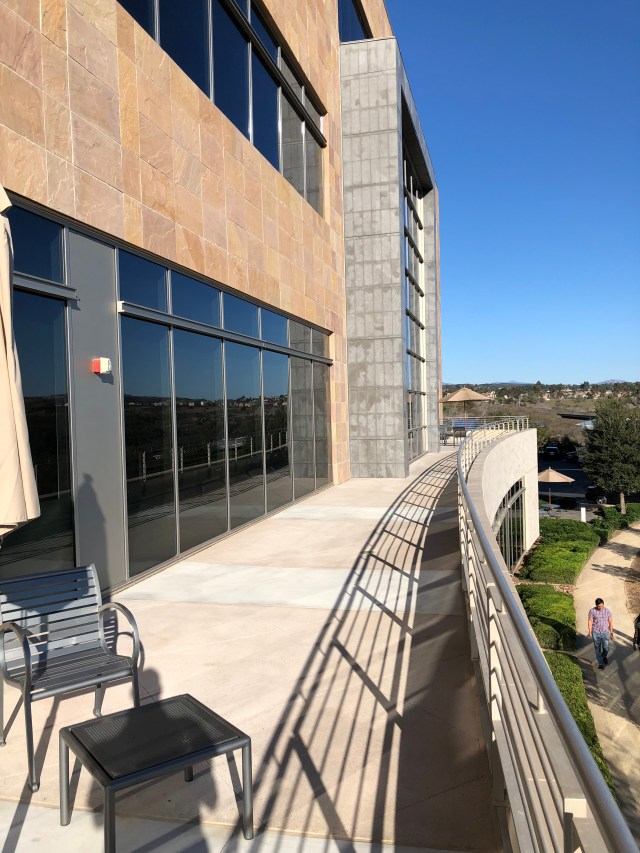
Got moved to another building at work. Nice view from the balcony.

Here’s the one I started in.

And my favorite part:


Bought this ages ago but finally tried it. The stiffness works well with the large Seiko and it’s quite comfortable, which was a nice surprise. Find it on Amazon. 13 bucks.


Via
We can do better than percentile latencies | theburningmonk.com, this amazing animation:

Every one of those has the same mean and standard deviation in both X and Y!
Read the linked paper for details, but this is by far the best visual education I’ve ever seen for why you absolutely cannot trust summary statistics.
Trump’s only true skill is the con, his only fundamental belief is that the United States is the birthright of straight, white, Christian men, and his only real, authentic pleasure is in cruelty. It is that cruelty, and the delight it brings them, that binds his most ardent supporters to him, in shared scorn for those they hate and fear: immigrants, black voters, feminists, and treasonous white men who empathize with any of those who would steal their birthright. The president’s ability to execute that cruelty through word and deed makes them euphoric. It makes them feel good, it makes them feel proud, it makes them feel happy, it makes them feel united. And as long as he makes them feel that way, they will let him get away with anything, no matter what it costs them.
Read the whole thing. I don’t want to devolve into another rant-y political blog, but this is worth sharing.

As part of my series of posts on gigabit Internet connections I had a friend ask about hardware, which is currently spread across multiple posts. Here’s what I’m running with a bit of details for each item. I’ll go from the outermost layer inwards.
All equipment must be low power.
No cooling fans.
Reliability is worth paying extra.

The modem is supplied by Spectrum, as their only approved model, and is DOCSIS 3.1. A bit bulky but low-power, reliable and delivering the promised speed. It’s linked via a short cable to my Ubiquiti ER-4 router/firewall. I had to upgrade from the ER-X as explained here, I wasn’t able to get line speed out of the ER-X and rather than fight that I upgraded to the ER-4. So far, it’s been great and I recommend it without hesitation.
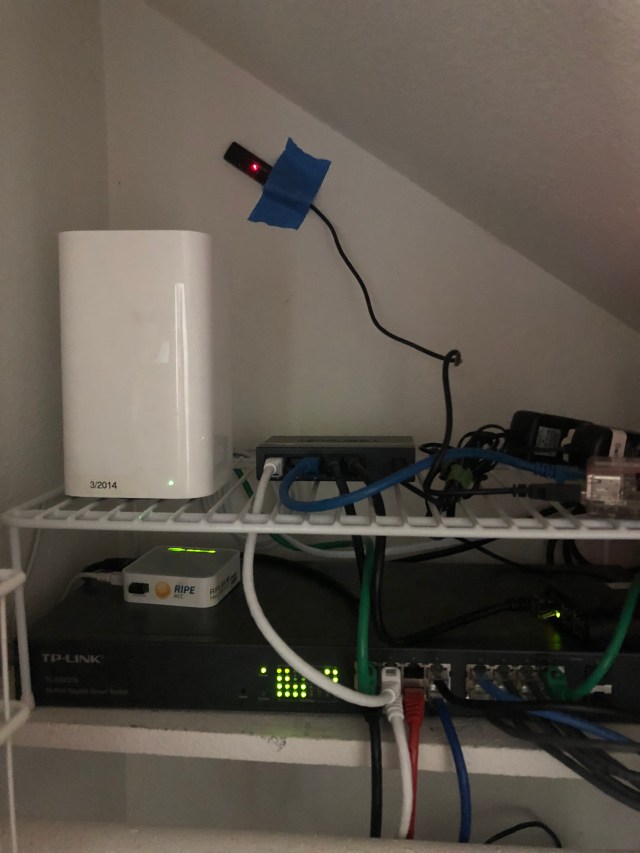
I wanted a backbone that’d handle lots of load, give me the ability to monitor/tweak, and generally be awesome. For an ethernet switch, that means
I bought the TP-Link TL-SG2216 which is a 16 port version; you can get more ports in the same switch. It’s been a good choice, right now I’ve got some bug with SSL on the web interface but the switch and SNMP have been flawless. I should have paid for more ports; if you squint at the picture you can see a 5-port dumb switch I had to daisy chain in to add more ports. Ahh well.
I have had much better luck using access points as opposed to all-in-one, so I use and recommend that. In my case, that’s the no longer sold Apple AirPort Extreme 802.11ac in access point mode. I disable disk sharing, DHCP, etc, etc and it runs for months and months with no problem. Note that I have very heavy usage, with upwards of 50 clients ranging from laptops, IoT, phones, tablets, etc, so the split AP/router configuration should also work for small biz or advanced home networks too.
A bit more detail about Wi-Fi Gigabit internet, the WiFi link.
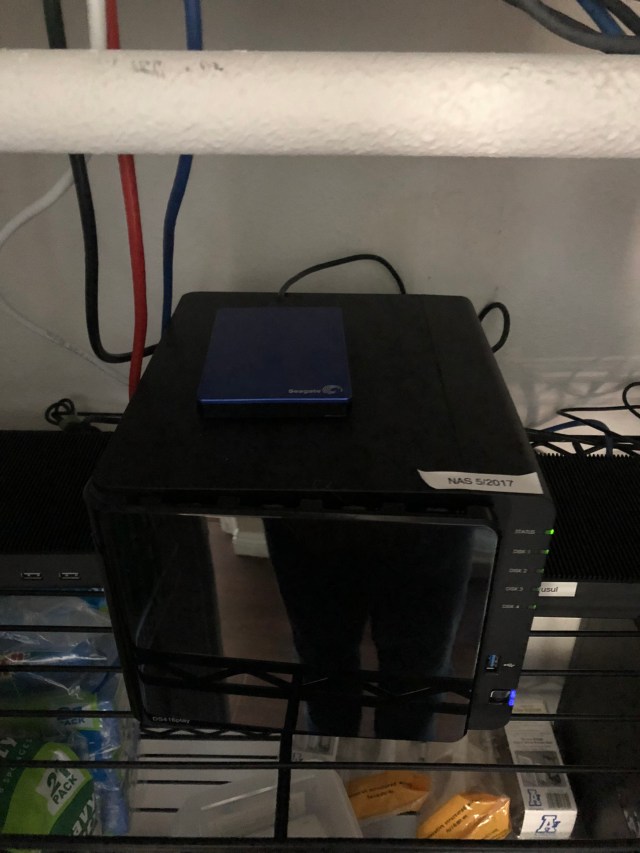
That’s my four-drive Synology DS416play. It’s a drive server, basically, but Synology makes great software so I also run other services on it that I used to host on Debian:
It’s a great little machine and my second Synology. Quiet, reliable and fast – I run the dual gigabit links to the switch and use the bridged mode, so I’ve got ~200MB/sec available.
I mentioned this in Staying sane and well-read with tab sets ad blocking and RSS – I adore this thing! I use a gen-1 pi for hardware and it provides DNS-level ad filtering for every device on the network.
Note that the DHCP server on the NAS gives out the Pi-hole’s IP as the DNS server to use, and the Pi-Hole is setup to use the NAS as its upstream. That way you get ad blocking plus local resolution. Takes a bit to configure that way but the results are excellent.

After an outage I added the APC Back-UPS Pro BR1500G and external battery pack. Since the entire set of hardware uses 65 watts, this provides around 300 minutes of power, more than enough to keep running and nicely avoiding server problems due to the short 1-second glitches that I see about once a week.
Found via Four short links (side note: this feed should be on your must-read list. Consistently superb.), a fascinating Twitter thread from Charity Majors:
In distributed systems, the hardest part is often not finding the bug in your code, but tracking down which component is actually the source of the problem so you know what code to look at. Or finding the requests that exhibit the bug, and deducing what they all have in common.
…
The most effective way to structure your instrumentation, so you get the maximum bang for your buck, is to emit a single arbitrarily wide event per request per service hop. We’re talking wiiiide. We usually see 200-500 dimensions in a mature app. But just one write.
…
Any and all unique identifying bits you can get your paws on: UUID, request ID, shopping cart ID, any other ID <<- HIGHEST VALUE DETAILS
The entire thread is worth at least two read-throughs. I’m still pondering.
For me, the current team is more about structured logs into Splunk and extracting metrics and call geometry from UUID and spans, so the idea of a 200-500 element event per call is new, compelling and … feels correct. Like, I need to figure out how to start doing this awesome new thing here too. Especially for serverless, where you can’t log into the server and poke around; all you have are logs and/or events.


Desaturated orange Barton band – I love this color.

 ultracrepidarian