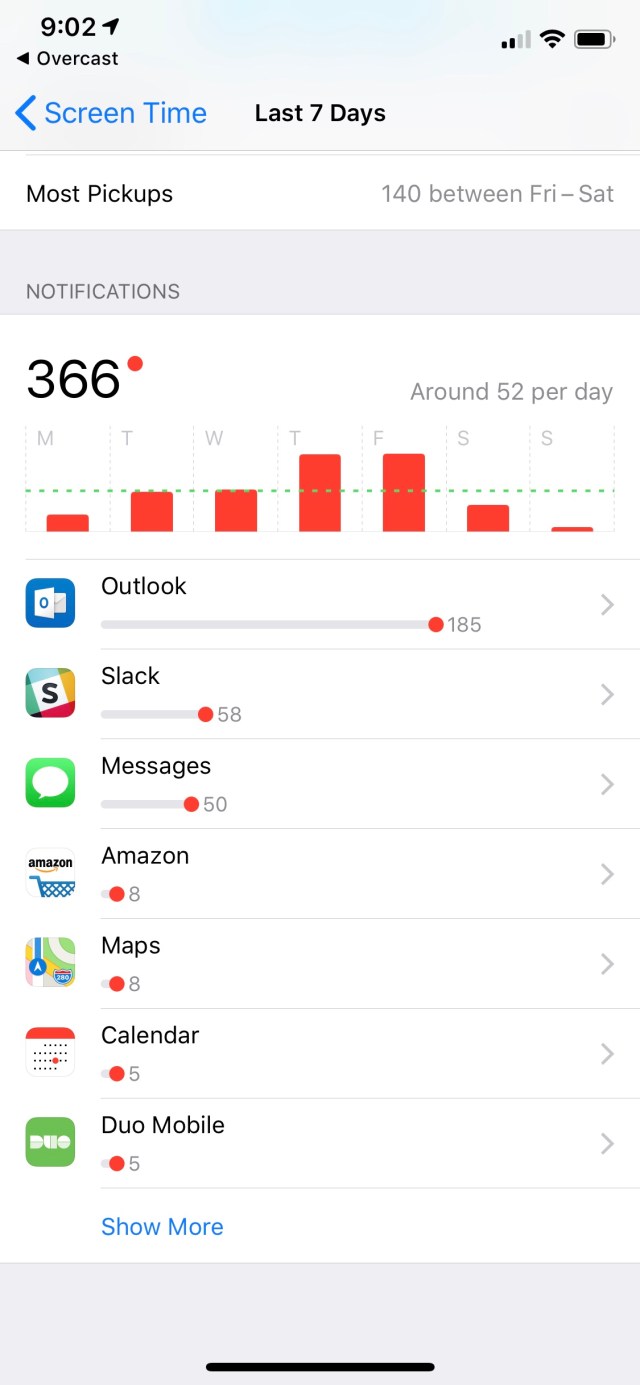
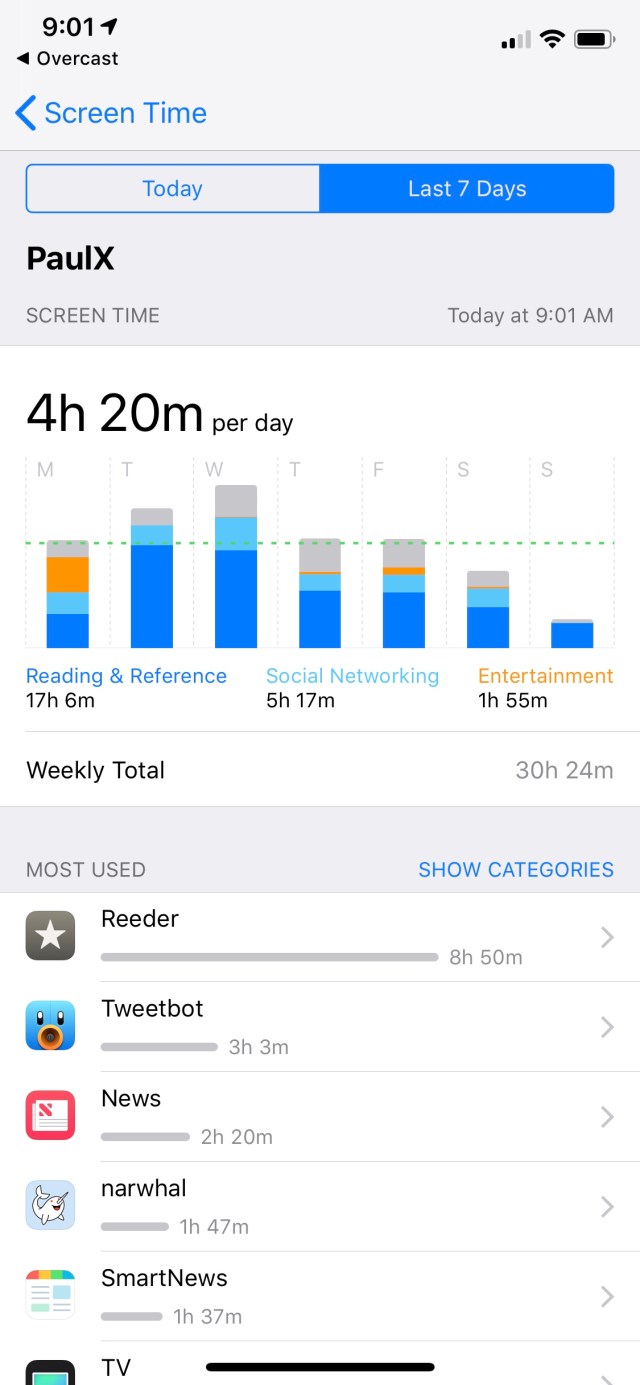
No big surprises. I heart RSS and use Reddit and Twitter for entertainment.
ultracrepidarian: a person who criticizes, judges, or gives advice outside the area of his or her expertise.


No big surprises. I heart RSS and use Reddit and Twitter for entertainment.
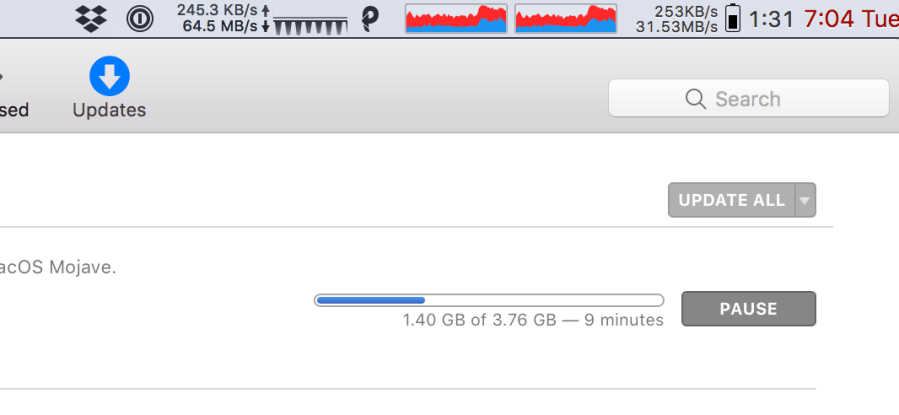
The latest batch of Mac and iOS updates came out this week, and at 1 to 4GB per device, they will load your internet:

xcode alone is a staggering 3.76GB… damn.

The two meters are iStatMenus and PeakHour, both paid and both worth your money. You’re seeing the difference in time durations, so PeakHour is showing 64.5MB/sec and iStatMenus is measurig 31.53. The PeakHour measurement is queried from the SNMP counters in the the router. Here’s the full PeakHour setup:

I have it setup to query the NAS, the router and the managed switch. I mean, why the heck not?

After watching this very cool video I went shopping for a UV camera. They are super rare, much harder to find than the infrared camera I got some time ago. I found the Sunscreenr for $80:
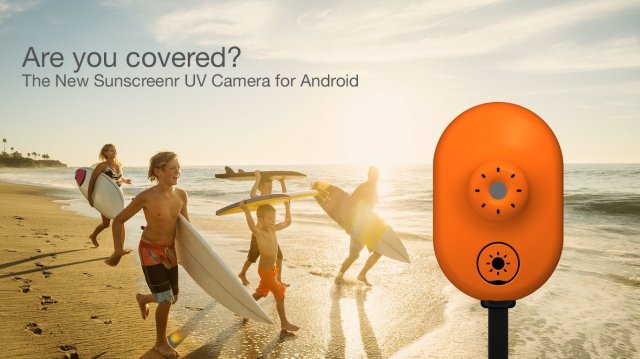
There seem to be, at present, none that are iOS compatible, so this was the best option that I could find. It’s took a while to find an Android device from the pile and get it working. (I had to buy a special USB OTG cable to connect my Yubikey for 2FA, really silly!) but its up and working, and friends, the world in UV is weird:


Things to note: My glasses reflecting and blocking UV (just like it says on the tin), skin damage seems more visible, and my light grey car looks almost black. The sky is grey and my daily face sunblock seems pretty good.
So far, it’s money well spent – I’ve already used it as quality control on the kids’ application of sunblock. It’s a good investment if you live someplace as sunny as this.

Spotted a bunch of antennas on the streetlight today:

Looks like three pairs of antennas, in three sizes. Hillcrest neighborhood, one block from the DMV. Anyone?
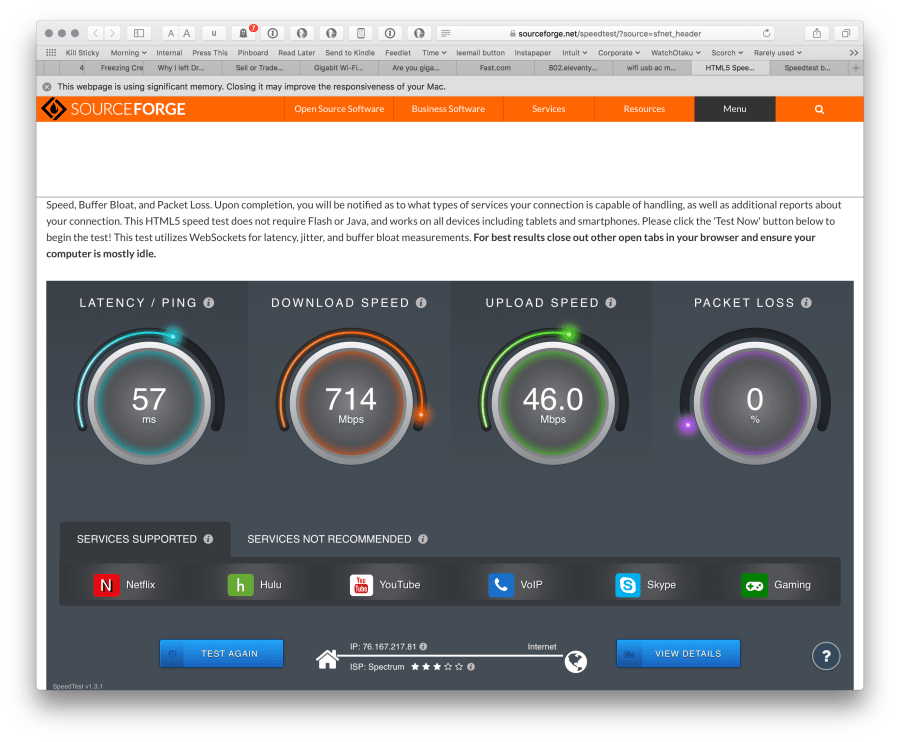


So now that I’ve got “Gigabit” home Internet I’m doing reading about WiFi, because my WiFi tops out around 400ish megabits (45MB/sec) of usable throughput. While researching, I found more bandwidth-testing sites as linked above. The fast.com site is something Netflix made, which is a great idea since that’s there core business and they can refer customers there for a quick test. I don’t actually have 1.3gigabit, but it’s a flattering screenshot. 😉
On Wifi, I get

That’s an Apple Airport Extreme (A1521) and MacBook Pro (Retina, 13″, early 2015, A1502) using 802.11ac, on a 5GHz/80MHz channel. From what I’ve read so far, maximum WiFi usable (ie HTTP) goodput is around 650Mbits, so I’m not far from best-case. Our house is around 1800 square feet, so a single access point provides great coverage, the issue right now is that a gigabit ‘net drop is just plain faster than the wifi you can buy right now. 😉 First world problems…
The Airport Extreme is and has been an excellent choice. It does 3×3 MIMO, according to the wonderful Mactracker. From opening System Information/WiFi on the laptop, I appear to have the Broadcom BCM43xx. I know from the Ars Technica article that some MacBooks have the BCM94360CS with 3×3 MIMO; if I do that’d explain my good speed results.
One of the advantages gained by spending more on Apple hardware; it’s lasted well and is better engineered. I bought them in 2014 and 2015 respectively, so this is not new.
I’m going to hold fast and not buy anything for now. For my friend Tom, whose laptop is older, I’d recommend a ‘600Mbit USB AC WiFi’ off of Amazon for $15. The Airport Extreme was discontinued this year, but they can be found used easily and its 3×3 with 6 antennas really has been superb.
For gigabit in general, see my other posts – you really need to be thorough choosing modem, router and switch before you try to do WiFi.
This is an interactive book which aims to be the best place on the internet for learning SQL. It is free of charge, free of ads and doesn’t require registration or downloads. It helps you learn by running queries against a real-world dataset to complete projects of consequence. It is not a mere reference page — it conveys a mental model for writing SQL.
I expect little to no coding knowledge. Each chapter is designed to take about 30 minutes. As more of the world’s data is stored in databases, I expect that this time will pay rich dividends!
Found this on Hacker News yesterday, a beautiful, interactive and free SQL course. Send this to your junior engineers! I’m passable at SQL, and I had a good time working through some of the problems. It’s well structured and uses a very … unusual… data set.
via Select Star SQL

I chose this at Costco, and my then-girlfriend and mother both contributed to it.
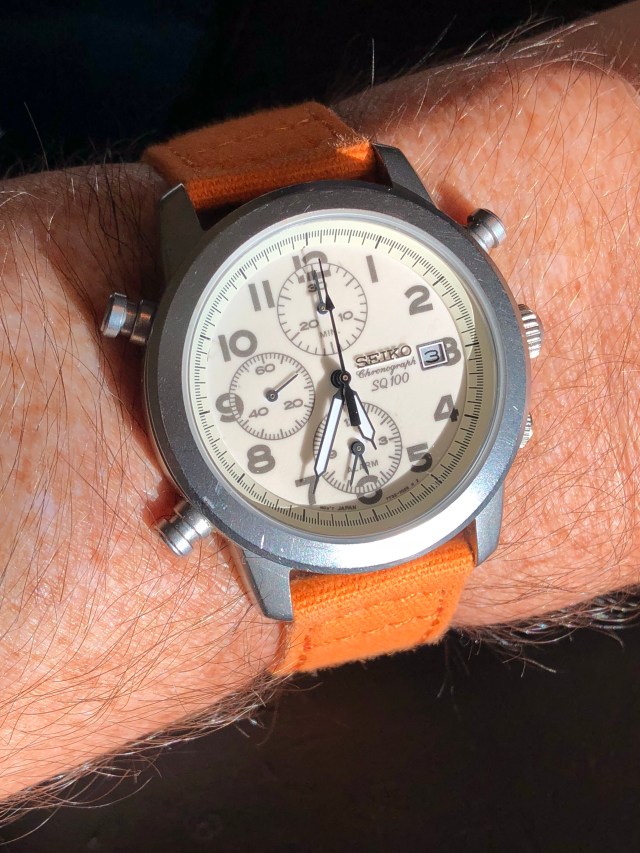
Basic Seiko, 7T32 quartz with chronograph, alarm and lume dial. Served me all through grad school and Fermilab, only to be replaced by a Blue Angels Citizen when I started flying. I recently sent it to Seiko in NJ for a battery, gaskets and crystal and am rediscovering why I loved it. It’s just a wonderful, versatile, easy to wear thing that disappears on the wrist.

I had written before about these with great anticipation, and ended up getting my first takedown request over it. Heh. Well, the embargo is gone and there are posts on multiple sites complete with nice press images, yay!
Briefly, the first three are out with more to come. One 800-piece limited edition, where the yellow-detail version has improved accuracy to the tune of 5 seconds per year. List price $3,500 for that, $3,200 for the regular editions.
SBGN001:

Man I love that one. Subtle dial texture, should be stunning in person. Having had my Seiko with gold accents for a while I think that the yellow would rock.
SBGN003:
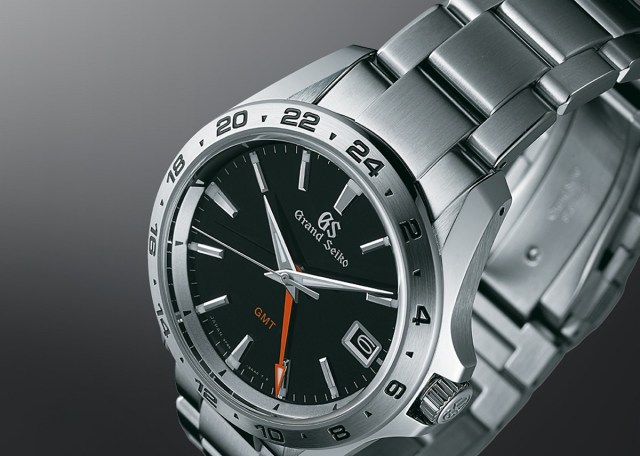
Basic black. Safe color choice. I wish the others had the white-on-black date wheel that this one has.
SBGN005:
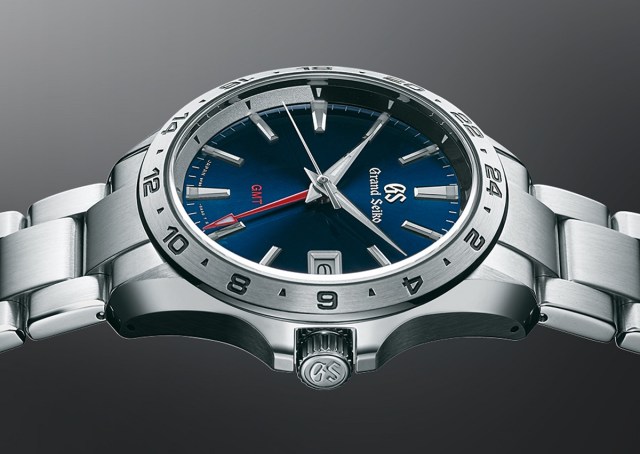
That will, I predict, sell quite well. Right between too bold and too boring, and of course blue is super trendy.
All of these are super, versatile watches with features that make a huge difference in utility:
These are the closest thing I’ve ever seen for a ‘one watch’. (Assuming, of course, you are OK with quartz). I’m in love.
O&O ShutUp10 means you have full control over which comfort functions under Windows 10 you wish to use, and you decide when the passing on of your data goes too far. Using a very simple interface, you decide how Windows 10 should respect your privacy by deciding which unwanted functions should be deactivated.
O&O ShutUp10 is entirely free and does not have to be installed – it can be simply run directly and immediately on your PC. And it will not install or download retrospectively unwanted or unnecessary software, like so many other programs do these days!
Bookmarked for if I switch to Windows.
via O&O ShutUp10

A friend asked me for a few sources of watch straps, so I’ll start a page here that I can share around. I’ve bought a lot of straps and bracelets, probably in the 1-2k range if you count watch-specific bracelets, so I’ve got lots of opinions to share. Here’s a quarter of my current collection:
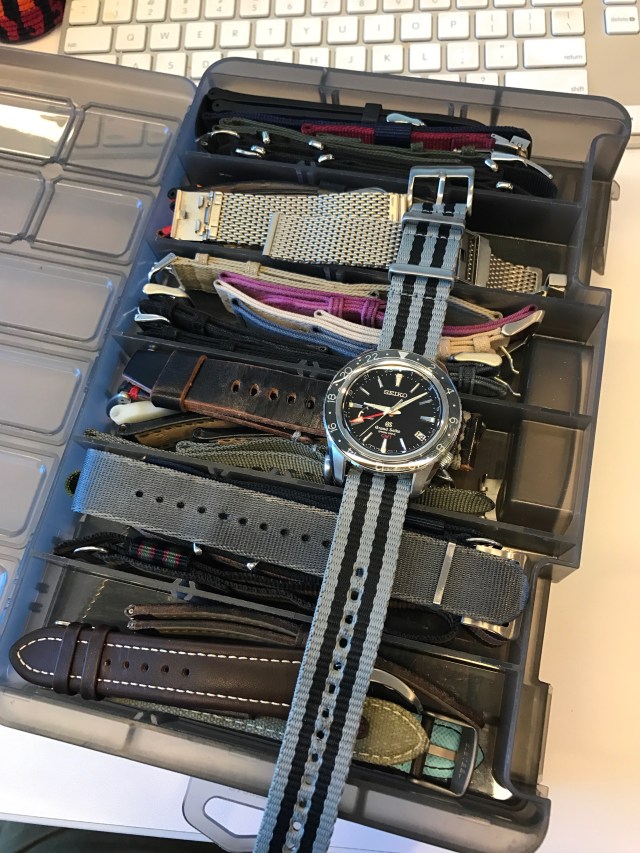
But first, Paul’s Rules for Strap Acquisition:
… buy the bracelet. Often, watches are offered with and without the bracelet. Buy the bracelet when you get the watch even if you don’t want it immediately.
Why?
Because bracelets are specific to a watch. In particular, the end links are nearly impossible to fit and/or find properly. So buy the bracelet; swap it it out if you want but I’ve never once regretted having it. They cost a lot more if you return post-sale to buy the bracelet by itself. For example, IWC wants over $1,000 for an Aquatimer bracelet.
Similarly, if the factory strap has a ratcheting/extensible clasp, buy it. See that post for reasons and details.
… buy the factory leather straps. They’re OEM’d anyway, the markup is severe, and since leather only lasts a year or two, your value for money is poor. Buy a fancy custom one from ABP or Camille Fournet if you want, it’s still a better deal.
If the factory buckle or deployant is to your liking, you can often buy them separately and they are easily fitted to a strap.
… buy watches with non-standard lugs. Oris Aquis, IWC Aquatimer, VC Overseas, Tudor North Flag… all great watches, but finding third-party straps is at least a hundred times more difficult.
This page will probably need lots of expansion and edits; for now I’ll sketch out the major topics and links for later. Leave a comment if you want, it’d be good to know which pieces are useful to know more about.
I was going to write this up, but this Barton page does it better. Read that and come back. Covers sizing, how to fit a NATO, wrist size and more.
If you want more opinions, there’s a WUS forum dedicated to straps and bracelets that is a deep well of knowledge.
For leather, I recommend kangaroo for versatile/comfort, Cordovan for sheer beauty, and calf for comfort/price. You can get real alligator, but it’s import/export controlled, meaning that you need paperwork to sell a watch with a gator strap, and the one I bought isn’t all that awesome.
Erika’s Originals MN straps are like $80 each, but the backstory (French parachutists, see this story) and actual straps are very cool. I have two, and they work on lugs from 20 to 22mm and are pretty good especially in hot weather.
As of August 2018, Erika has a lower-priced competitor in The Watch Steward. According to this WUS thread they are solid competition. I’ve not seen them yet.
Also cool is the Hirsch Robby sailcloth. It’s $110, very expensive for a rubber strap, but the build detailing and comfort are worth it to me. Instead of a slab of rubber, it’s articulated and vented, so you can wear it with less induced sweat when the weather heats up:

the Robby is my pick for best rubber strap I’ve had.
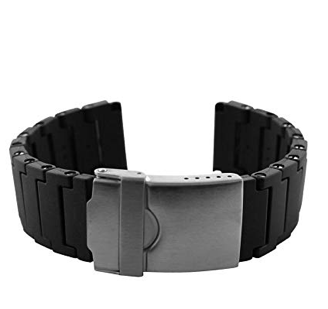
I think these were introduced with the JLC Navy Seals or maybe the Luminox 3000 series. It’s made a like a bracelet, with individual links, but instead of metal the links are plastic and thus very lightweight. They’re a bit pricy at $35, but I quite like mine. Also note that you can use an Exacto to fit them into smaller lugs, I shaved a 22mm into a 20mm and it looks okay. Get them on Amazon.
You don’t need to spend a hundred bucks to get a great strap, let’s talk both vendors and materials for straps that you can afford and stock up.
Silicone rubber – undoubtedly the Barton 2-piece silicone:

This are about 1/9th the price of the Robby and have quick release, it shouldn’t surprise you that I have quite a few of these!
I used to buy these from Timefactors and had quite a few:
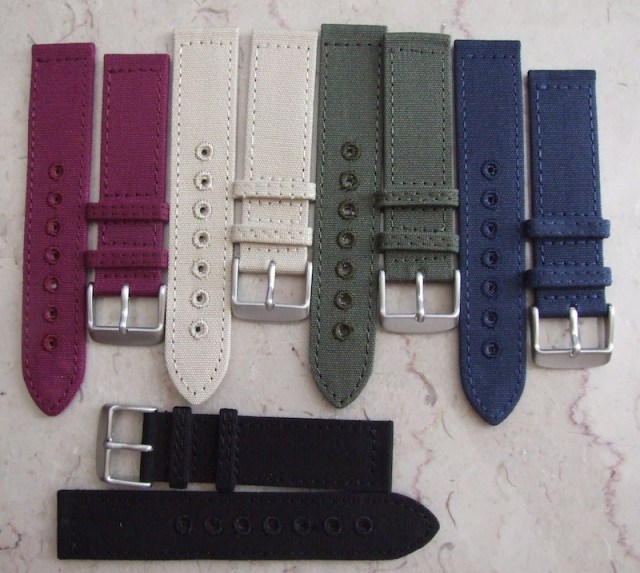
However, they no longer list them, so now I buy and recommend the Barton 2-piece quick release, which I get via Amazon. Well made and I love the quick-release straps.

So many options! Here, my favorite vendors are:
These are different. They fit literally any wrist, since the tang goes into the weave, and they’re like eight bucks each on cheapestnatostraps.com. I bought a fistful and promptly lost them all to my daughter who loves being able to color-match any outfit in a few seconds. Good in warm weather, waterproof but can poke your skin a bit with loose plastic and they definitely look a bit cheap.

As I said above, this is hard. Here’s the only time I’ve managed good end-link fitment:

That’s a cheap ($20ish) 3-link Oyster with hollow end links, that I painstakingly hand-filed to fit the watch. It took a couple of hours, and the bracelet is still uncomfortable with sharp edges. So yeah, but the factory if you possibly can.
For bracelets, start at Strapcode. Good stuff. I’ll have more posts on bracelets since there’s lots of depth here to explore.
 ultracrepidarian